
Never alone…
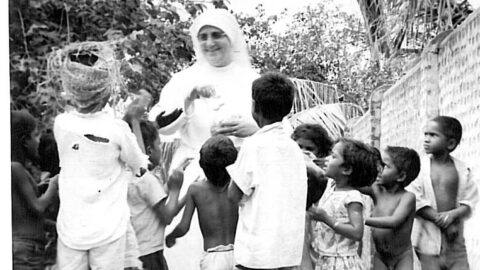
In 1980, when we Missionaries of the Immaculate arrived in Guinea-Bissau, the country had only recently gained independence, after centuries of Portuguese colonization.
In schools, on Saturday mornings, the teacher gave religious instruction in Portuguese… but the children understood almost nothing because most of them spoke only the local language.
At that time in Mansoa, the town where we lived, there were just 20 Christians, the people who, through neighborhood or work, had come into contact with the Portuguese. One day, a young man decided to be baptized a second time. Do you know why? “Because,” he said, “the first time they washed my head, but I didn’t understand.”
The Gospel had not yet been proclaimed in the villages, and upon our arrival, we immediately responded to the first requests for catechism from two villages. We taught catechism in the local language, Balanta, and, knowing the importance given to the elderly in the social and cultural context, we decided to begin speaking about our great fathers in the faith: Abraham, Isaac, Jacob…
As we gradually learned more and more about the local language and culture, I became aware of the role that a particular social figure played in these villages: “The man of the path.”
This person was held in high esteem by the people and served as a mediator in all aspects of life. For example, if a young man sought a wife, the mediator walked ahead, carrying the jar of wine in his place, and led him along the path to the girl’s father’s house. Once they reached the house, it was always the mediator who spoke, due to the esteem in which he was held, and who introduced the suitor.
The Mediator also served for other needs, such as finding a job and more.
This figure, similar to today’s coach, was therefore a guide in social relationships and relational understanding, according to various objectives. He was certainly someone who had already undertaken the traditional initiation process, and who was perfectly familiar with the values and limitations of his culture. The man on the path is the one who stands before you and opens the way to your life, your desires, and your future.
As I learned more about this figure, I realized that Jesus says of himself in the Gospel of John, “I am the Way, the Truth, and the Life” (Jn 14:6). The only “Way” to reach the Father, the Essence of Truth, and the certainty of eternal life, is Jesus.
In my work engaging with the Balanta culture, I also better understood the demands of evangelization. Thus, to make Jesus known, it wasn’t appropriate to introduce the great people of the faith, the Fathers of the Old Testament, first. Instead, it was important to begin with the answer to this question: “Who is Jesus?”
Jesus is the man of the journey sent by God the Father for us.
The figure of the traditional mediator thus offered me the necessary language to foster an understanding of Jesus’ identity and his relationship with us. Jesus is a trusted mediator: ours because he is the Son of Mary; God’s, because he himself is part of the Trinity, so concerned with us that he gave his own life to guide us toward the fullness of life, here and in the afterlife.
Jesus still stands before us today, and as he walks, he turns to look at us; he makes himself known throughout the turning points of our lives, and he challenges us, inviting us to follow him.
He, the Man of the Way, is the only one capable of leading us to achieve our greatest desires and goals, in this life and the next. He is the only one who can bring us before the Father, his and ours.
Never alone!
Have you ever recognized Jesus walking ahead of you? Have you ever noticed that he cares about your goals, and that as you walk, he turns to look at you and encourage you?
Have you ever considered that you too can be the man or woman of the journey for others, walking with them, in front of them, and together with every person in the world?
Never alone!
Sr. Maristella De Marchi