The synodal journey, which many believed to be concluded, now opens to its truest phase: that of profound listening and communal conversion. From the diocese of Orano, we wish to welcome this new stage with faith, while the universal Church, under the guidance of Leo XIV, continues the legacy left by Pope Francis: to be a Church that welcomes, builds bridges, and walks together.
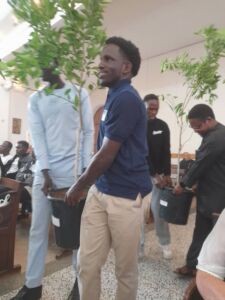
The path of the church, a tree that will bear fruit
From Algeria, in the Diocese of Orano, we wish to share our desire to continue to accept the challenge of the Synod and the proposals it receives.
October 2024: The second and final assembly of the Synod on Synodality in Rome led to the publication of the final document, a 60-page text that discouraged many from reading it… Then Pope Francis left us in April 2025, and Pope Leo XIV found himself inheriting this entire open path, just as Pope Paul VI had inherited the Second Vatican Council, already underway, from Pope John XXIII. In his first greeting, Leo XIV showed he accepted the challenge, stating off the cuff that we are a missionary Church, a Church that builds bridges, fosters dialogue, always ready to welcome with open arms.
HAVE WE NOT ALREADY FORGOTTEN?
In case of doubt, here’s a brief summary of the Synod’s milestones… up until today, which brings a perhaps unexpected twist. Do you remember?
Stages of the Synod (2021-2026)
Diocesan and National Phases
In 2021, Pope Francis announced, surprising everyone, a Synod unlike any other: in its shared preparation, its composition, and its management. From October 2021 to August 2022, the process would begin in each diocese, the faithful would be consulted through workshops and meetings, and the national summaries would then be sent to Rome. For our part, we worked quite well in our diocese of Orano, and the summary sent to Rome was the work of the four Algerian dioceses.
Continental Phase
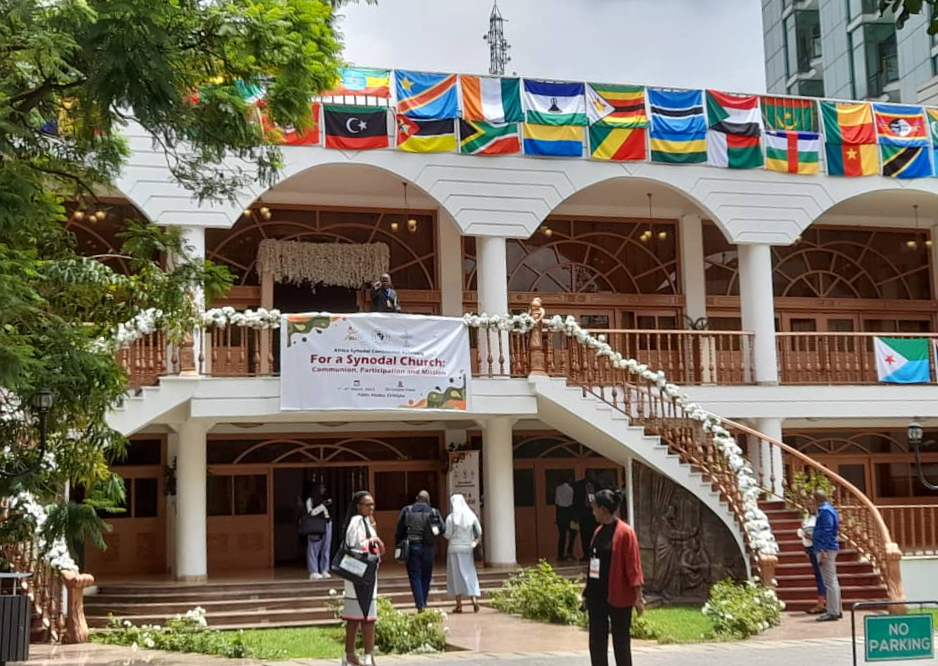
February-March 2023: Continental assemblies meet to explore local contributions and adapt them to the context of each continent. The African Continental Assembly was held in Addis Ababa, and this author participated.
Ordinary General Assembly
First session, October 2023: Bishops and laity in Rome for discernment and work on the issues addressed. Father Michel Guillaud, of the Diocese of Constantine, now its bishop, represents us all.
Second session, October 2024: Publication of the final document.
We thought it was over. But it’s not over! Indeed, what must happen now is what interests us most: the local implementation phase, in dioceses and communities, of what has been said, from June 2025 to December 2026. Then there will be: diocesan evaluation assemblies (2027), followed by evaluations at the level of episcopal and continental conferences (2027-2028). And, to conclude this period of work, a new ecclesial assembly is planned for October 2028 in Rome, following the publication of a working document in June 2028.
How do we react to these new proposals?
We’re hearing a variety of reactions…
There’s a certain amount of discouragement, as if all this were pointless. We’re a little fearful of change and question it; we don’t trust it to be truly for the good of the Church. Some say there wasn’t enough transparency, and the Synod itself didn’t truly decide the agenda. Others, however, expressed enthusiasm for the openness and dialogue of a Church on a journey.
Here’s a brief reflection written by Bishop Davide Carraro of PIME.
Our Church: round table or rectangular table?
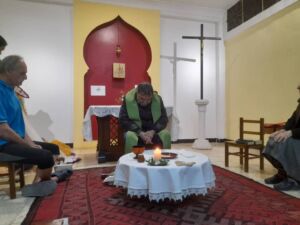
The round prayer table
When I think of the synodal Church, I think of the image of the round table.
A round table isn’t designed for privilege. It has no corners: everyone sees all the participants, everyone listens to whoever speaks… There’s no “head of the table” who sets the tone, but a circle that gathers and unites. The very shape invites fraternity, sharing, acting together, and shared responsibility. A round table is a place where no one remains invisible, where every voice, even the faintest, is heard. It is the image of a Church that walks together: no one is too far away, no one is hidden behind a corner. Here, differences don’t create separation, but rather enrich dialogue. It is around a round table that a Church of brothers and sisters is built. It is around a round table that forgiveness, the gesture of taking the hand of the most vulnerable to support them, becomes possible.
Conversely, at a table with corners, some people on the sides dominate the conversation; while those at the corners themselves are excluded. There are “strategic” places and others that are “marginal.” A non-round table often indicates rigidity, isolation, and hierarchies that create more distance than proximity.
How often in our communities, parishes, and families do we rush to sit in a corner? We remain on the sidelines and allow the table to lose its roundness, becoming a place of conflict, a place of division.
We thought it was over. But it’s not over! On the contrary…..
As a small diocese in Algeria, we want to be a Church with a round table, welcoming everyone, even those who normally don’t make their voices heard.
So, to achieve this goal, how do we want to live our implementation phase? What do we want to change? And what do we intend to already be living with a synodal spirit?
Let’s work on a few things: the use of conversation in the Spirit, shared discernment, everyone’s participation, the role of women and lay people, listening especially to young people, attention to those who are on the sidelines, courageous and trusting dialogue with contemporary life, the structures we have available (pastoral, economic, parish councils, etc.), and communication.
We thought it was over. But it’s not over! On the contrary…..
Sr. Gabriella Tripani, Algeria