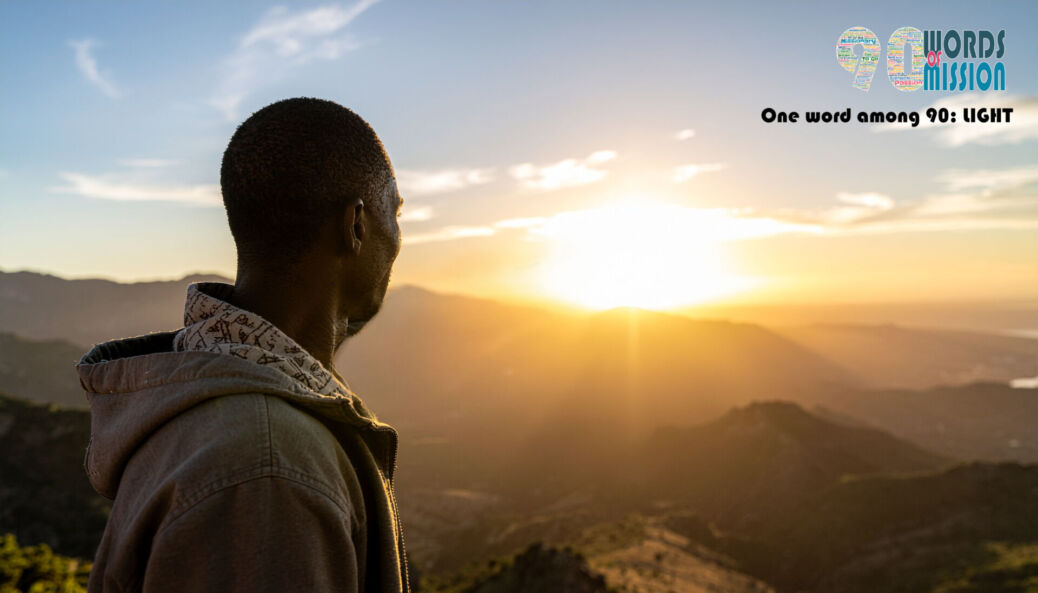
Called to be light of hope among ourselves and in our apostolic realities, let us learn to live this being of LIGHT by deepening the Word that illumines our steps each day, and by looking at the examples of those who live around us.
“We are light that falls from the eyes, upon the sunsets of my land, upon new days. LISTEN TO ME.”
I entrust the opening of this brief article to the words of Elisa, one of the most cherished Italian artists, and to her song “Luce (Tramonti a nord est)”, winner of the Festival of Sanremo in the year 2001. It is precisely this light that I wish to speak about: a light that shines through the eyes, even when everything around seems to be enveloped in darkness.
The protagonist is a man of around fifty years of age, whom I shall call Quisif. A man who, despite the succession of negative events — not caused by any choice of his own, but by circumstances far greater than himself — has never once stopped placing his hope in God. Who has never ceased to believe that, beyond the darkness, there is always a light waiting.
One would never think, merely by looking at him, that he could be a person so thoroughly pervaded by the wisdom of the Gospel — that wisdom which belongs to the small ones, to the men of God. Faithful to the traditional African religion, polygamous, deeply immersed in Balanta culture and tradition, Quisif never tires of reminding me that hope in God must never be allowed to fade. I call Him Christ; he calls Him N’Hala — which in the Balanta tongue means God — but it is always the same reaching out to that Creator who truly holds in His hands the destiny of our daily life.
Never an ill-placed word; rather, always a request for forgiveness or a word of encouragement. Never an outburst of anger, but a calm and measured voice in telephone conversations, which begin almost invariably with an apology for some delay or for some supposed failing that, in truth, I have never once noticed. It is the sign of a profound care for the other, of a genuine and sincere attentiveness.
The light that belongs to the “men of good will” — as Karl Rahner recalls in his spirituality through the concept of Semina Verbi — grants him a clear and serene gaze, one that you perceive immediately upon sitting beside him. Despite the sea of adversities he has traversed, and the injustice he has suffered on account of a life choice made with courage, stubbornness, and love, Quisif has never lost that light. I do not believe it is any mere outward appearance: I truly believe he belongs to that category of persons to whom God has gifted a large heart and a pure gaze.
It is a light that continues to radiate from his light-brown eyes — a light soaked in hope and trust in God. A light that remains burning in the waiting for the dawn of a new day: for his land, for his life.
Sr. Anna Marini, Guinea Bissau