The rain seemed to pursue him.
On 13 April, Algiers — which the Pope had just left to continue his journey — awoke to brilliant sunshine after the previous day’s downpour, as if the city were breathing again after a long weeping. In Annaba, however, where the Holy Father visited the archaeological site and celebrated Mass, the rain arrived to greet him, and showed no desire to leave.
Annaba — ancient Hippo, the city of Saint Augustine, where the great Doctor of the Church served as bishop for more than thirty years.
The sisters of our community in Hassi Messaoud made their way to Annaba. We missionary sisters from Algiers and Mascara, however, were granted the grace of receiving the Holy Father at the Basilica of Our Lady of Africa in Algiers. A choice had to be made: there was not enough space to welcome everyone in Annaba, for the place is small, and we had also opened our doors to our Muslim friends who wished to be part of this moment together with us Christians.
The stages of this brief, intense, and historic visit of Pope Leo XIV to Algeria have been recorded everywhere, and so I shall not repeat them in detail. On the morning of the 13th, he arrived at Algiers airport, where President Abdelmadjid Tebboune received him. He was then taken to pay his respects at the Maqam Echahid, the memorial to Algeria’s martyrs, where he concluded his first address with the Beatitudes. Afterwards, he was received in private at the El Mouradia Palace, where he delivered a speech to the authorities — a speech well worth reading in its entirety.
Pope Francis had written in Fratelli Tutti of the need for «a model of social, political and economic participation ‘that can include popular movements and invigorate local, national and international governing structures with that torrent of moral energy that springs from including the excluded in the building of a common destiny.». In this spirit, Pope Leo urged those holding positions of authority not to fear this vision, but to promote a vibrant, dynamic, and free civil society, in which young people in particular are recognised as capable of helping to broaden the horizon of hope for all.“The true strength of a nation,” he reminded them, “lies in the cooperation of everyone in pursuing the common good. Authorities are called not to dominate, but to serve the people and foster their development.” The Catholic Church, he added, with all her communities and initiatives, also wishes to contribute to the common good of Algeria, strengthening that particular identity of a bridge between North and South, East and West.
The Mediterranean on one side, and the Sahara on the other, he said, represent geographical and spiritual crossroads of enormous significance — places of mutual enrichment among peoples and cultures for millennia. “Woe to us,” he warned, “if we turn them into graveyards where hope also dies!”
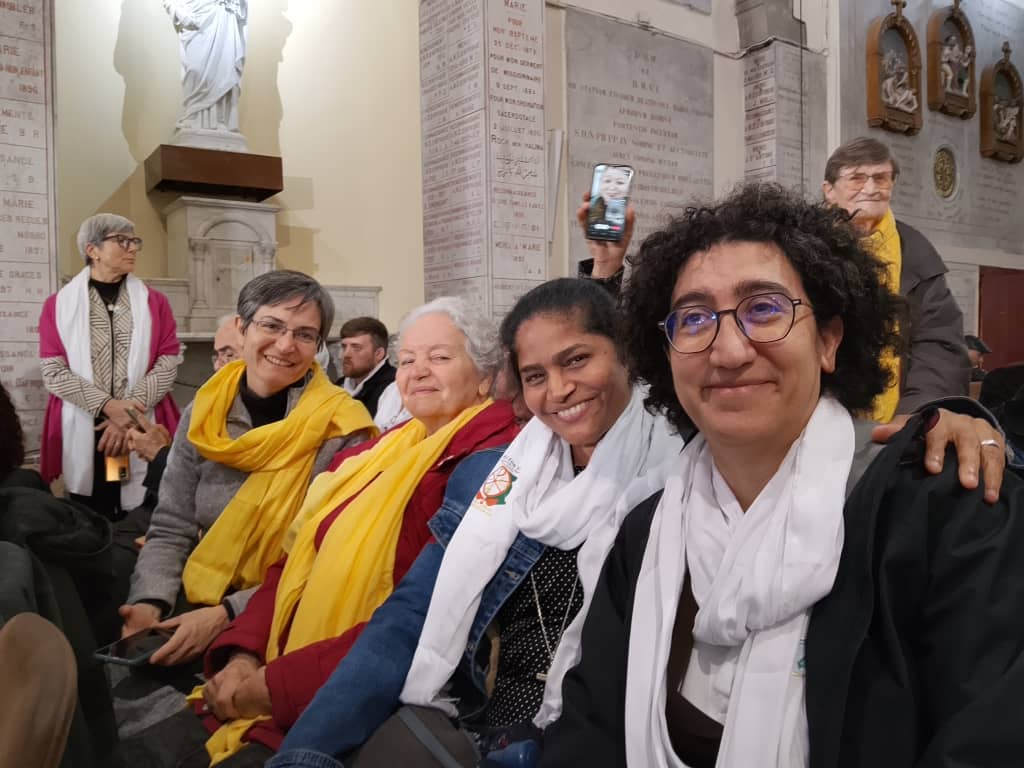
After his visit to the Great Mosque of Algiers and a private meeting with the Augustinian sisters at Bab el Oued, at their Centre of Welcome and Friendship — during which, I confess, for a few brief moments we almost wished we were Augustinians — came the gathering at the Basilica of Our Lady of Africa with the whole Algerian community. With all of us.
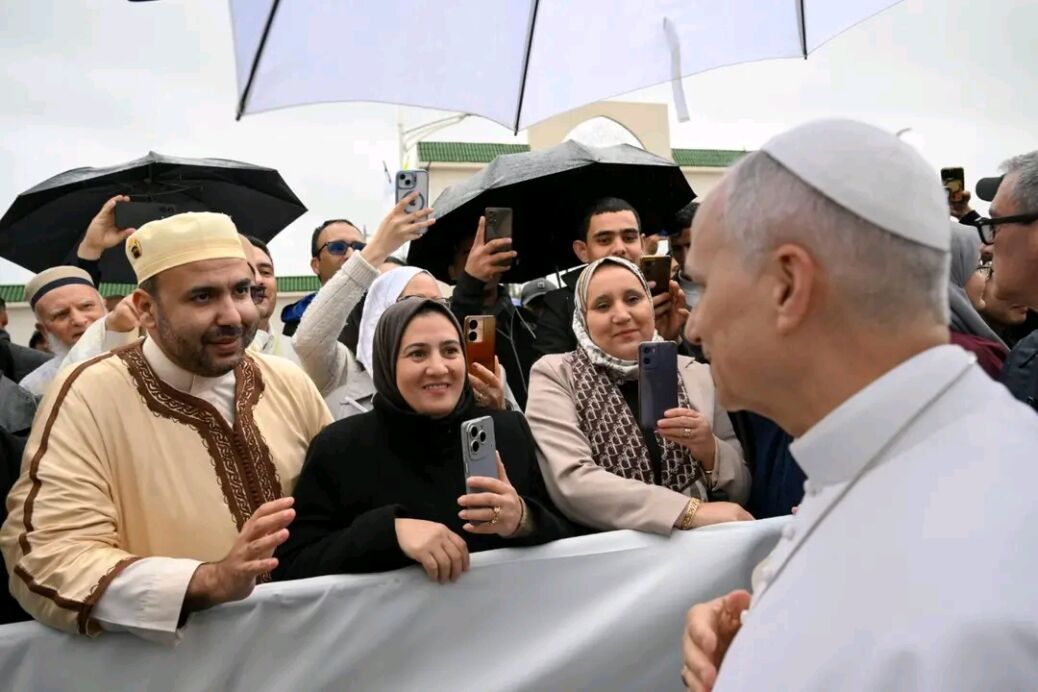
We lived that moment of encounter with the Pope with deep joy, together with our Muslim friends, for the Christian community here has meaning precisely when it opens itself in this way, in this communion. Even the hours of waiting were a time of true fraternity, and they passed very quickly indeed.
Then, when the Pope finally entered, interspersed with songs, we listened together to the testimonies of Sr. Bernadette, who works with disabled children in southern Algeria; of Ali, who stands each day at the door of the basilica welcoming visitors and pilgrims; of Rakel, a Kenyan student who lives the joy of an ordinary, lived ecumenism with other students in Tlemcen; and of Mounia, a Muslim friend who had the courage to offer her own testimony to Pope Leo as well. I wish to share a few fragments of what she said, for it was truly significant — her desire to give voice to this communion that defines us: with her Christian brothers and sisters, she said, they care for the most vulnerable, working side by side, “to welcome, serve, listen, care for, organise, find financial resources and work to ensure that activity centres are safe places that preserve the dignity of people,” sustained by the conviction that “to serve the human person is, above all, to serve God“.
She then told the Pope: “I visit my Christian brothers and sisters every day, and I see them pray, celebrate, and live their vocation with faithfulness” — and: “without confusing our paths, I who pray to God according to the Muslim tradition, find myself in the same interior disposition: seeking God, learning to love him more, and allowing myself to be transformed in order to become better towards others“.
The Holy Father then took the floor, and in his address to the community, in which he wove together their experiences with quiet attentiveness, three words emerged at the centre: prayer, charity, and unity — “three aspects of Christian life that I consider to be essential — particularly in light of your presence here”.
On prayer, he spoke of how Ali had shared his experience of service at Notre Dame d’Afrique, where many come to enter into silence, to express their concerns, to pray for their loved ones, and to meet someone willing to listen so they can share the burdens they carry in their hearts, noting that many find peace and are happy to have come. “Prayer unites, humanizes, strengthens and purifies the heart,” the Pope said. “Through prayer, the Church in Algeria sows humanity, unity, strength and purity, reaching places known only to the Lord“.
On charity, he reflected on how Sister Bernadette had explained that from a simple, initial gesture of closeness — visiting the sick — there blossomed first a community centre and then an increasingly structured care organisation, becoming an authentic community where many people share moments of joy and sorrow, united by bonds of trust, friendship and fellowship.
And finally, on peace and unity: children eager to walk together, to live, pray, work and dream, in a faith that does not close in upon itself but opens outward, that unites without erasing, draws close without making uniform, and builds a true fraternity. “In a world where divisions and wars sow pain and death among nations, in communities and even in families, your living together in unity and peace is a great sign“, the Pope said. Theirs is a message all the more powerful for being lived in simplicity and humility.
Outside, the rain accompanied all of this.
Dacyl, another Muslim friend, a mother who comes regularly to pray at Notre Dame d’Afrique, had been assigned a place on the esplanade — the red-badge area outside the basilica. She experienced the entire gathering in wind and rain, and afterwards described the day as “formidable, full of magnificent joy — a unique occasion, absolutely worth living“.
Effettivamente, lo abbiamo aspettato da quando, appena eletto, si è presentato alla piazza e ha nominato sant’Agostino. Da allora ci siamo detti: “Verrà”. Ecco, è venuto.
Indeed, we had been waiting for him ever since, newly elected, he appeared on the loggia and mentioned Saint Augustine. From that moment, we said to one another: “He will come.” And he came.
But the story does not end here. We have also the testimony of other sisters who attended the papal visit — in the rain. This is what moved them most, what touched their hearts most deeply and left its mark:
“The time we spent waiting — finding ourselves among so many familiar faces, both Christians and Muslims, with such friendship, with the joy of being together, of sharing in an event that moved everyone. That is what touched me”.
“The way the Pope spoke to the Muslims, the way he spoke of unity and peace, and the testimony of Mounia — showing how it is possible to live and work together, sharing important values. I think of my own country of origin, where there are not many Muslims, and this minority situation had stirred fears in me, perhaps even prejudices. Mounia’s testimony, and the words and approach of the Pope, challenged me deeply, and they offer me a path forward”.
“What touches me is the good I sense this visit can bring to Algerian society — because to encounter, to see up close, is altogether different from merely hearing about something. And it does not matter that only a few could truly meet him in person; a visit is in itself a gesture of closeness, a form of visibility. And then the good it brings to the Christian community, to the Christians of this country, who feel that he came for them, for us — that he is near, and that we belong to a single Church, a family that welcomes, far greater than what we are able to experience here in Algeria”.
“The reactions of the people, who were glad the Pope had come. More than one person expressed joy at seeing that he had truly, finally, arrived. And the country received him beautifully. From this visit I hope to see fruit soon — in relationships, in a growing mutual esteem. I greatly appreciated his simple manner, a visit made with words of peace. Strong words… but words of peace… not of domination”.
“When he crossed the threshold of the basilica, after all the preparation and the waiting, I was swept by a great wave of emotion. He — the Holy Father — was truly there. He came, and he is near”.