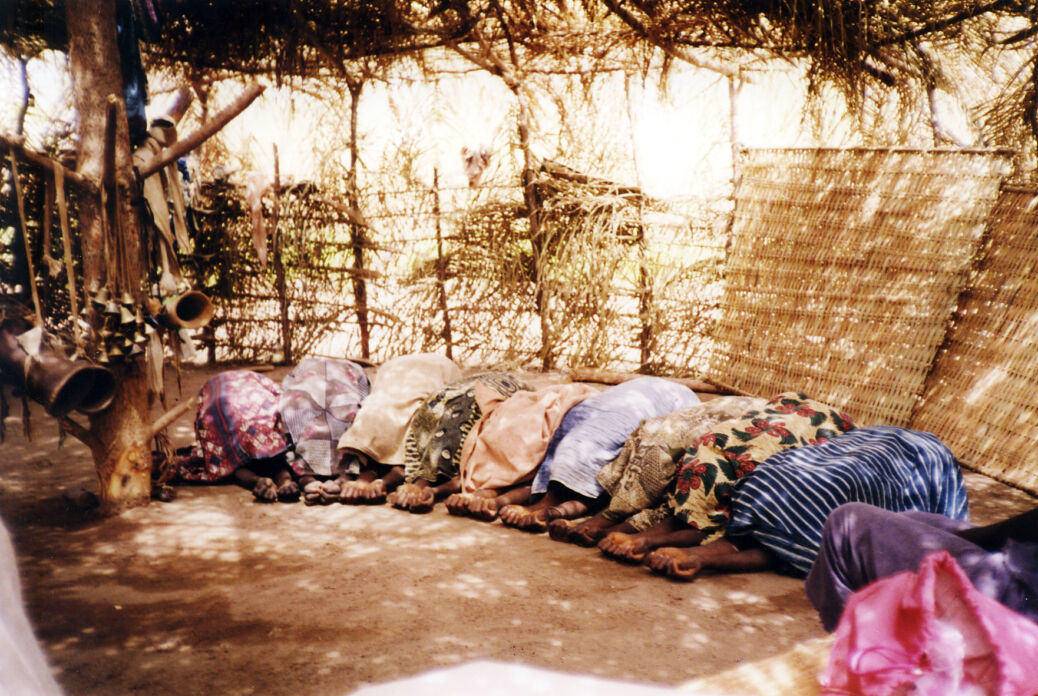
In the Balanta culture, education is through “SECRET.” Some things are kept secret and communicated only at the right time, through initiation rites that involve knowledge to which one is only introduced at a certain time, at a certain age. To understand this “method,” it is necessary to understand the meaning of the term “KNOW” in the Balanta culture and, more generally, in African Bantu cultures: knowing is not just knowing, but living, transmitting something and assuming.
Let’s take an example: in our country, grandpa, dad, grandchild, grandmother, mom… whoever wants watch television together. Different generations are hearing the same message at the same time, even if they have different understandings, which the communicator often doesn’t take into account.
In the Balanta culture, however, the process of learning is combined with the process of assuming responsibility. Therefore, it must be gradual. How do these steps unfold in the initiation process?
At 12 to 14 years of age, boys enter the “Mpebe” class, the “adolescent shepherds”, who are able to accompany the herds to pasture. They are dressed simply, with few external signs.
Adolescents aged approximately 15 to 17 belong to the “N’Hae” class. They live in groups for a certain period of time, move from village to village, and have to be available for family work when required. They are dressed simply and traditionally: short hair, loincloths, and bracelets made from plant branches on their wrists and arms.

From 18 to 24 years old, the group then moves on to sexual initiation: the young men become part of the “N’Hess”, a word meaning “young groom”. The young men are initiated into sexual relations with a married woman and change social roles, becoming farmers; they are ready for marriage to a woman chosen by their family. Their clothing changes: from the rudimentary and basic style of the N’Hae to a more refined outfit, appropriate for someone who must be attractive.
At this point, the circumcision rite takes place: the man enters the “Alante ndan” group, meaning “Big Man”. It is the most important rite, through which a man becomes fully responsible for his family and has a social role within the group. External signs: a cloth wrapped around the body and a red hat, a symbol of blood, that is, life. When the young man becomes old, the hat will be yellow, a sign of greater seniority and therefore respect.
Everything happens in SILENCE—that is, in SECRET! The secret doesn’t pass from one age group to another until one reaches the right age, according to one’s ability and responsibility. Members of each age group become aware of specific rights and duties, in accordance with their experience.
IN THE GOSPEL: “Tell no one until…” (Luke 9:21-22)
In the Gospel, Jesus says to his disciples: “Tell no one until I am raised from the dead.” Jesus also uses the method of secrecy; the mystery must be revealed at the right time to be understood. If you don’t follow a path of growth, of knowledge, of experience, of trust in the one you trust, you are incapable of knowing.
Of the disciples, only John experienced this journey up to the cross; the others understood only after Pentecost, that is, with the gift of the Holy Spirit. The gift that gives the ability to understand. It is the experience of the parents of John the Baptist who withheld their son’s name until they had to tell it to others… the Secret…
In our tradition, the final step in the education of faith is Confirmation, which is normally received around age 12! But do 12-year-olds have the capacity to deeply understand Christian values and the Christian path? Are they capable of taking responsibility for it?
From the traditions of the Balanta culture, we receive many insights for learning to embrace life and our faith: the need to go through a long journey of appropriating values, guided by those who are more advanced, by adults, by families, and by a broader community that has something to communicate and can guide us forward, gradually revealing the meaning of things. The Gospel and the person of Jesus also have a secret to reveal to us, a path of growth and responsibility that always lies before us…until its fulfillment!
Have you ever thought about looking at life and the Christian journey as a secret that reveals itself little by little to allow us to fully appreciate the meaning of things?
Sr. Maristella De Marchi
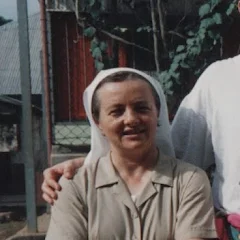 Sr Maristella left for Guinea-Bissau in 1980 as a member of the first group of Missionary Sisters of the Immaculate sent to this mission. A nurse and theologian, during the fifteen years she spent in the country she combined healthcare with social work, founding an agricultural cooperative to support the local community and developing nutritional and natural medicine programmes. An expert in the Balanta language, for which she compiled a grammatical and lexical system, she conducted in-depth anthropological research into local rituals as a means of building rapport with the people. Returning to Italy in 2000, she devoted herself to missionary outreach and, subsequently, to serving at Opera Prison with high-security inmates. Since 2022, she has been carrying out her ministry as a volunteer at the Redaelli geriatric institute in Milan, offering spiritual accompaniment and presence in numerous wards of the facility.